Linking to:https://youtu.be/chRObpetyBM
SAP 電漿水--天然的雷公水
SAP PAW -- Luí Gōng Tsuì
Forward 雷公水2 下一頁 >
PDF下載
電漿(plasma)是繼固體、液體和氣體之後的第四種基本物質狀態,富含未結合的正負離子(ion)、大量活性自由基(radical)、電磁輻射量子(quanta of electromagnetic radiation)和強電場(electric field)。
Plasma is the fourth state of matter after solids, liquids and gases. It is rich in positive and negative ions, and has a large number of reactive free radicals, quantum of electromagnetic radiation, and a strong electric field.
說起電漿,恐怕很多人都很陌生,但宇宙中卻有99%以上的物質處於電漿態。大自然環境下的閃電,就是我們最常見的電漿態。天上的雲在高速氣流中作激烈運動,分裂成一些帶負電的較大水珠和帶正電的較小的水珠。正電荷在雲的上端,而負電荷則在下方吸引著地上的正電荷,當兩極電荷形成的電壓大到可衝破絕緣的空氣時,閃電就發生了(靜電電壓可達幾百萬伏特),從而產生耀眼的閃電;閃電發生時,同時也放出很多的熱量,使周圍的空氣快速受熱膨脹,並且發出很大的聲音,這就是雷公聲。雷雨雲中的水珠受到百萬伏特的閃電解離時,即引發空氣與液態水珠之間各種類型的電漿化學反應。落下來的雨,即是我們熟知的雷公雨。然而人們對於電漿的認知不多,更遑論被閃電活化過的雨,只知道雷公雨所滋潤的植物生長得特別好。
Though many people may be unfamiliar with plasma, more than 99% of the matter in the universe is in the plasma state. Thunder is the most commonly encountered plasma state. The clouds in the sky move violently in the high-speed airflow, splitting into some larger water droplets with negative charges and smaller water droplets with positive charges. The positive charges gather at the upper end of the cloud while the negative charges are attracted to the positively-charged ground. When the voltage formed by the two-pole charges is large enough to break through the insulation of the air, lightning occurs (and the resulting electrostatic voltage can reach several million volts). When lightning occurs, it also releases a lot of heat, causing the surrounding air to rapidly heat up and expand, which results in a booming sound—thunder. When the water droplets in the thunderstorm clouds are dissociated by a million-volt lightning, various types of plasma chemical reactions are triggered between the air and the liquid water droplets. The rain that falls is the thunder rain as we know it. However, people don't know much about the plasma, or the rain activated by thunder. In Taiwan, we call it Luí Gōng Hō. Interestingly, plants moistened by Luí Gōng Hō grow particularly well.
引用大氣電漿在材料進行表面化學改質的製程早已行之有年。大氣電漿解離空氣中的氮和氧分子,進而與水作用,產生電漿活化水(PAW)。電漿水的主要物種(包括原子氧、單線態氧、超氧化物、臭氧、羥基(-OH)和原子氮),隨後藉由化學的作用產生次要物種,例如過氧化氫(H2O2)、過氧亞硝酸根(ONOO−)、一氧化氮(NO)、硝酸根(NO3−)和亞硝酸根(NO2−)離子等。自 2007 年首次發表關於電漿活化水抗菌作用的報告以來,已經廣泛證實電漿活化水所包含的活性氧物質(ROS,Reactive Oxygen Species)和活性氮物質(RNS,Reactive Nitrogen Species)(統稱為活性氮/氧物質)的化學性質和相對濃度與生物活性極其相關。
The process of chemically modifying the surface of materials by using atmospheric-pressure (AP) plasma has been around for a long time. The AP plasma dissociates nitrogen and oxygen molecules in the air, which then interacts with water to produce plasma activated water (PAW) with a number of primary species (including atomic oxygen, singlet oxygen, superoxide, ozone, hydroxyl radicals (-OH), and excited atomic nitrogen) which will then continue to react to form secondary species (including hydrogen peroxide (H2O2), peroxynitrite (ONOO−), nitric oxide (NO-), nitrate (NO3−), and nitrite ions ( NO2−)). Since the first report on the antibacterial effect of PAW published in 2007, it has been broadly confirmed that the antimicrobial activity of PAW is directly related to the concentration of these reactive oxygen species (ROS) and reactive nitrogen species (RNS), collectively known as reactive oxygen and nitrogen species (RONS).
這些RONS(Reactive Oxygen/ Nitrogen Species)在多處文獻已證明對於植物生長、食品防腐、水產品保鮮、微生物滅菌,水淨化、甚至生物醫學的癌細胞治療等多有助益。更何況電漿活化水僅使用純天然的空氣與水,即可取代現今需添加化學藥劑的應用。(Oehmigen et al., 2010; Shen et al., 2016; Thirumdas et al., 2018; Zhou et al., 2020; Herianto et al., 2020;)
These RONS have been proven in many studies to be helpful for plant growth, food preservation, aquatic product preservation, microbial sterilization, water purification, and even biomedical cancer treatment. What sets PAW apart is that it only uses natural air and water to achieve the above mentioned properties, which can potentially replace current processes that require the use of harsh chemicals.
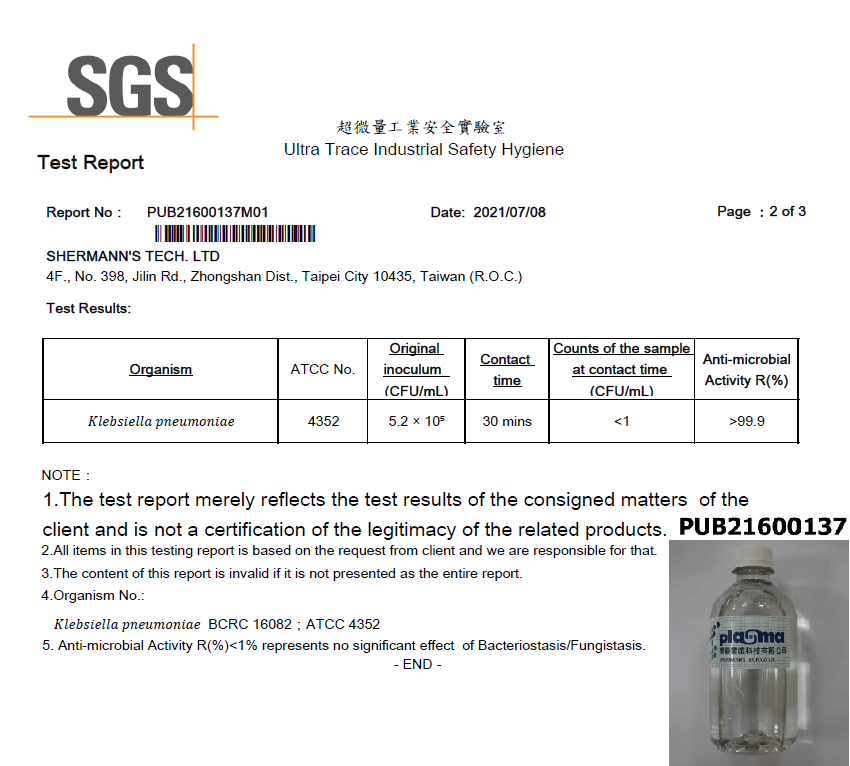
浸泡雪曼電漿之SAP-600-1024電漿水30分鐘後,
可有效消滅克雷白氏肺炎菌Klebsiella pneumoniae >5 log CFU/mL。
After soaking the SAP-600-1024 PAW for 30 minutes,
Klebsiella pneumoniae can be effectively eliminated (>5 log CFU/mL).
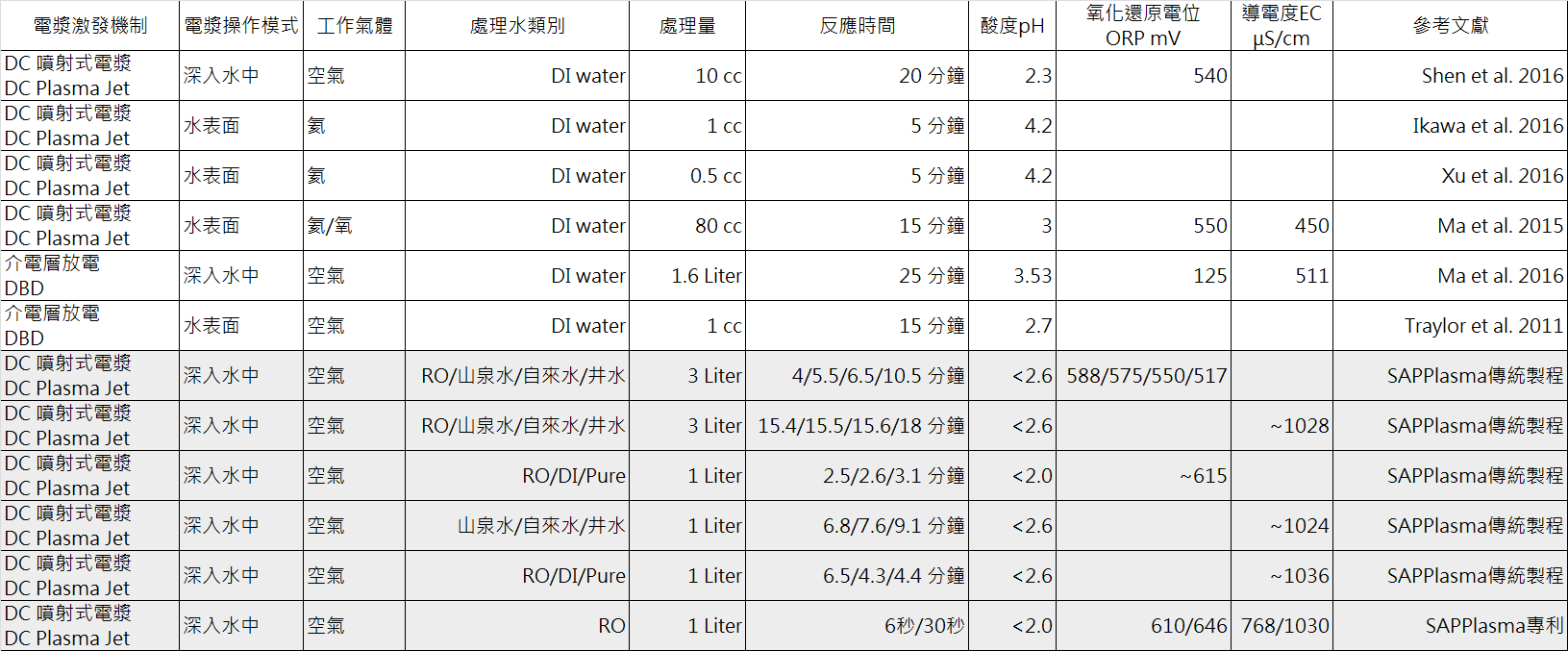
然而產生電漿水的機制有許多,文獻(Lukes et al.,2014)比較了各種電漿激發機制所生成之電漿水的化學特性,並指出介電層放電(DBD)的電漿激發機制,將產生較高的活性氮(RNS)的反應性物種,NO2−/NO3−濃度約3.5與3.86 mmol/L;直流式噴射式電漿,則可產生較高的活性氧(ROS)的反應性物種,H2O2濃度遠高於其他激發機制,約2.4 mmol/L。由於不同的電漿激發機制會產生不同濃度的活性氧物質(ROS)與活性氮物質(RNS)反應性物種,故它們會通過不同的化學反應滅菌機制,導致不同的抗菌效率與其他次要目的。因此,不同的應用需求,將會需要相對應的電漿激發機制,例如:醫療用途,期望活性氧物質的過氧化氫(H2O2)較高,以達到消毒殺菌之目的;農業用途則期望活性氮物質的過氧亞硝酸/亞硝酸根較高,除滅菌殺微生物外,還能同時賦予植物生長與發芽之用途。
There are many mechanisms for generating PAW. Lukes et al. (2014) compared the chemical properties of plasma water generated by various plasma excitation mechanisms and showed that the plasma excitation mechanism of dielectric barrier discharge (DBD) will produce higher RNS with NO2−/NO3− concentrations of about 3.5 and 3.86 mmol/L. The plasma jet can produce higher ROS with the H2O2 concentration of about 2.4 mmol/L , which is much higher than that produced by other excitation mechanisms. Therefore, different applications require their appropriate reaction species for PAW. For example, for medical purposes, the hydrogen peroxide (H2O2) of ROS is higher for disinfection and sterilization. For agricultural purposes, RNS is the most expected species in order to inactivate the bacteria and promote plant growth and germination.
活性氧物質(ROS)與活性氮物質(RNS)的濃度,可以通過測量導電度與氧化還原電位(ORP,mV)的變化來檢測。導電度(EC,μs/cm)越高,反應出過氧亞硝酸根離子濃度相對越高;氧化還原電位(ORP,mV)越高,反應出過氧化氫與羥基相對濃度越高(Lukes et al.,2012)。過氧亞硝酸鹽的半衰期很短,隨著電漿水靜置時間加長,NO2−逐漸轉換成NO3−,導電度(EC)逐漸下降,pH值也緩慢升高。過氧化氫與羥基的半衰期長,氧化還原電位(ORP)下降較慢,可保存時間較長。
The concentration of ROS and RNS can be detected by measuring changes in electrical conductivity (EC, μs/cm) and oxidation-reduction potential (ORP, mV), respectively. The higher the EC, the higher the concentration of RNS, including nitrates and nitrites. The higher the ORP, the higher the concentration of ROS, including hydrogen peroxides and hydroxyls. (Lukes et al., 2012).
雪曼電漿藉由高電壓加速電子,以及改變電漿頻率的激發機制,解離空氣中不同比例的氮氣分子(N2)與氧氣分子(O2),製造出指定的極性官能基團(polar-functional group),例如:OH-,CH-,NH-,COOH-,O-……等.)。不用蠻力加大瓦數與安培數來斷鍵,而是找到分子間的震動頻率,藉由共振效應來協助斷鍵,選擇性地製造各種化學自由基(radical)。雪曼電漿操作功率為350至1,000W,電流不超過0.7 Amp,電壓大於6 kVolt。並且,雪曼電漿不是火花放電(ARCING FREE),可直接沉浸入工作液體中製造電漿活化液,並不會有電擊的工安疑慮。藉由變頻電漿的特性,即可達到各類型激發電漿的功效,滿足量產需求。
Shermann's Atmospheric Pressure Plasma (SAPPlasma) uses high voltage to accelerate electrons and changes in the excitation mechanism of the plasma frequency to dissociate nitrogen molecules (N2) and oxygen molecules (O2) in different proportions in the air to produce the desired polar functional groups (e.g., OH-, CH-, NH-, COOH-, O-, and others). Instead of using brute force to increase the wattage and amperage to break the chemical bond, SAPPlasma finds the vibration frequency between the molecules and uses the resonance effect to help break the bond to selectively create various chemical radicals. The operating power of the SAPPlasma is between 350 to 1,000W, the current is at most 0.7 Amp, and the voltage is greater than 6 kVolt. Moreover, the SAPPlasma is an arcing free plasma, meaning that it can be safely and directly immersed in the working fluid to make PAW. With the characteristics of variable frequency plasma, the effect of various types of excitation plasma can be achieved to meet the demand for mass production.
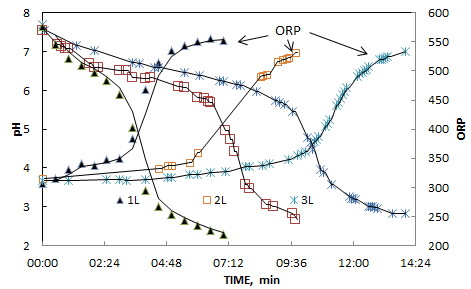
不同體積之自來水經過SAP電漿活化隨時間之生成指標
The generation index of different volumes of tap water after SAP plasma activation.
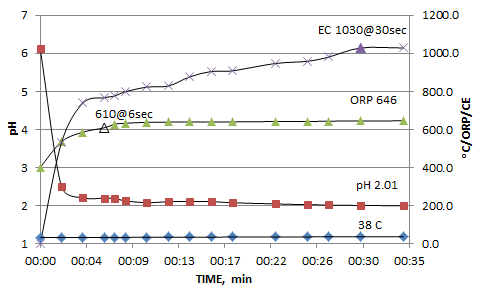
SAP專利電漿水製造之一公升RO水電漿活化隨時間之生成圖
The generation index of the PAW with one liter RO water
produced by SAP patented PAW modus
很多文獻皆指出,由於電漿水內的活性物質持續在反應,因此其保存期限極短。室溫保存下,多則10天。雪曼電漿的變頻電漿技術,成功快速拉高ORP與EC值,常溫保存下已達60天。其中pH值與ORP些微下降,EC值則緩慢上升中。甚至將電漿水煮沸後,其兩項指標也已維持兩個月不變。
Much literature have found that the life of PAW is extremely short since the RONS in PAW is reacting continuously. At room temperature, the storage duration is fewer than 10 days. The frequency adjustable plasma technology of SAPPlasma has successfully increased the ORP and EC values of the SAP PAW quickly, and the resulting SAP PAW has been able to be preserved at room temperature for over 70 days. Its pH and ORP dropped slightly, while the EC value was slowly increasing. Even when the SAP PAW was boiled, the EC and ORP values have remained unchanged over two months.
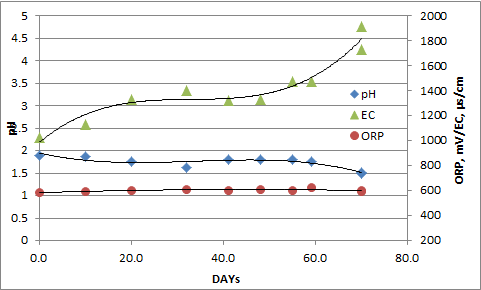
SAP電漿水衰退紀錄
Life time of the SAP PAW
電漿水之物化性質文獻整理
Salient results of studies conducted on physical and chemical properties of PAW